Your Skin Is Smarter Than Your TikTok Feed

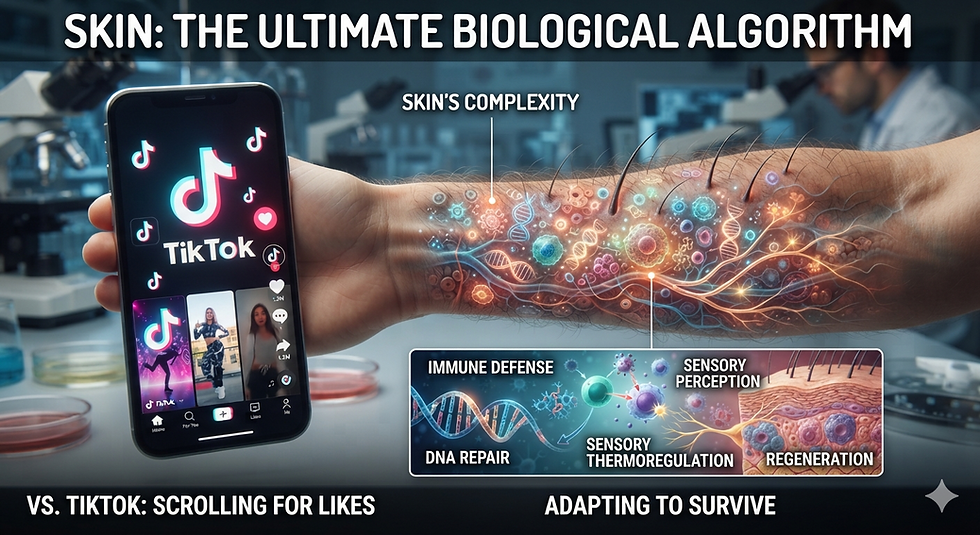
Your skin has a trillion roommates. And you're evicting them with a loofah...
Let's start with a confession that will make half of dermatology Twitter lose its mind: we are overwashing, overprotecting, and overcorrecting the largest organ in the human body — and social media is the accelerant.
Here's the paradox. We live in an era of unprecedented dermatologic innovation. We have biologics that can silence the molecular screams of atopic dermatitis. We have JAK inhibitors that turn off inflammatory cascades like flipping a circuit breaker. We have tapinarof, roflumilast, nemolizumab — a pharmacologic arsenal that would have seemed like science fiction a decade ago. And yet, the most common dermatologic intervention in America isn't a prescription. It's a TikTok video telling you to stop using the prescription.
The Algorithm Has a Rash
Here's the dirty secret of health content on social media: accuracy is inversely correlated with engagement. A cross-sectional study of dermatology content shared across platforms found that 44.7% was rated imprecise and 20% confusing — and the imprecise content got more engagement. Read that again. The algorithm doesn't reward the right answer. It rewards the most emotionallyactivating answer. Fear, outrage, and contrarianism are the currency of virality, and your skin is collateral damage.
This isn't a bug. It's the business model.
A systematic review of dermatology-related content on TikTok found that only about one-third of videos were posted by board-certified dermatologists, while the majority came from non-medical influencers. The non-dermatologist content was more likely to contain inaccurate or misleading claims — and it consistently outperformed accurate content in views, likes, and shares. The platform's recommendation engine doesn't distinguish between a peer-reviewed meta-analysis and a ring-light monologue from someone who sells an unregulated serum in their bio link.
And it gets worse. A study analyzing health misinformation dynamics found that corrective content — the debunking posts, the "actually, here's the evidence" videos — reaches a fraction of the audience that the original misinformation reached. The rebuttal never catches the rumor. Misinformation has a first-mover advantage that evidence can never overcome within the architecture of these platforms. The information ecosystem has an autoimmune disease: it's attacking its own credibility.

The Sunscreen Wars: A Case Study in Algorithmic Dermatitis
Take sunscreen — the one thing dermatologists universally agree on, and the one thing TikTok has decided to relitigate. The FDA's Maximal Usage Trial showed that organic UV filters can be absorbed systemically. Cue the panic. But here's what the panic merchants leave out: no clinically significant adverse effects have been linked to these filters in humans. The Nambour trial — a randomized controlled trial, the gold standard — showed sunscreen reduces squamous cell carcinoma by 38%, basal cell carcinoma by 25%, and melanoma by 50%. The AAD's position is unequivocal: the benefits outweigh the theoretical risks.
But "sunscreen is safe and effective" doesn't get clicks. "IS YOUR SUNSCREEN POISONING YOU?" does. One analysis found that anti-sunscreen content on social media generated 3 to 5 times more engagement than pro-sunscreen educational content. The algorithm took a nuanced pharmacokinetic finding — systemic absorption without demonstrated harm — and turned it into a public health crisis. Dermatologists are now spending clinic time deprescribing fear that was prescribed by an algorithm.
The Skincare-Industrial Content Complex
And then there's the seventeen-step skincare routine. The one with the double cleanse, the acid toner, the vitamin C serum, the retinoid, the niacinamide, the peptide moisturizer, the SPF, and the slugging layer. Each product endorsed by a different influencer. Each influencer with a different affiliate code. Each affiliate code feeding a recommendation engine that serves you more content about more products you "need."
This is not skincare. This is a subscription model wearing a lab coat.
The evidence for multi-step routines is thin to nonexistent. What the evidence does show is that overwashing and overuse of active ingredients disrupts the skin barrier, alters the microbiome, and can trigger the very conditions — irritant contact dermatitis, sensitization, paradoxical acne — that send patients spiraling into more products, more content, more algorithmic rabbit holes. A longitudinal study from Norway found that high-frequency cleansing was associated with lower microbial diversity and higher abundance of pathogenic Staphylococcus. We are pressure-washing a coral reef and wondering why the fish are dying.
The algorithm doesn't care. It just knows you watched the whole video.

The Real Diagnosis
The provocative truth isn't that any single product is dangerous. The provocative truth is this: we have a misinformation dermatitis — an inflammatory condition of the information ecosystem that is causing real harm to real patients. The pathophysiology is clear:
An emotionally charged claim enters the content ecosystem.
The algorithm amplifies it because engagement is the only metric that matters.
Corrective content is suppressed because nuance is boring.
Patients change behavior based on misinformation.
Clinicians spend limited visit time treating the misinformation before they can treat the skin.
This is a feedback loop. And like any inflammatory cascade, it requires intervention at the systems level, not just the individual level.
So what do we do?
We prescribe evidence the way we prescribe medicine — with dosing, context, and follow-up. We build platforms where credibility is a ranking signal, not just engagement. We stop pretending that "doing your own research" on a platform engineered to maximize watch time is the same as reading a systematic review. We meet patients where they are — yes, on TikTok, yes, on Instagram — but we refuse to let the algorithm set the standard of care.
Your skin is an ecosystem. So is your information diet. And right now, both of them need a better formulary.
The best skincare routine? The one backed by evidence — not an affiliate code.


Comments