Your Skin Is Not Addicted to Steroids: The TikTok Lie Costing Patients Their Health

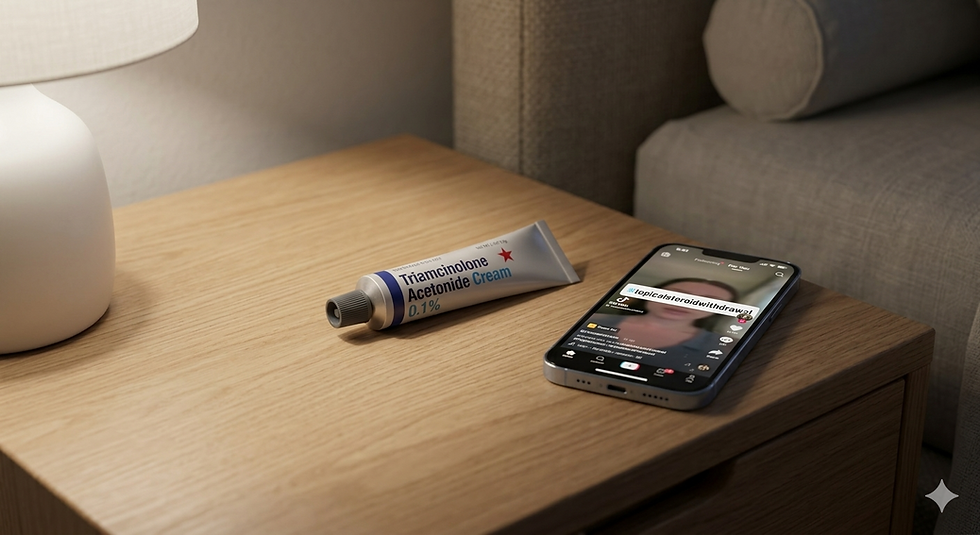
There's a war being waged on your nightstand...
On one side: a tube of triamcinolone, prescribed with care, dosed with intention. On the other: a 47-second TikTok video from someone with 2.3 million followers and zero medical training telling your patient to throw it in the trash.
The steroids are losing.
The Algorithm vs. The Evidence
Here's the uncomfortable truth about modern dermatology: the most powerful force shaping patient behavior isn't a clinical trial, a guideline, or a board-certified physician. It's an algorithm. And that algorithm has decided that fear sells better than science.
The hashtag #TopicalSteroidWithdrawal has hundreds of millions of views across social media platforms. The narrative is seductive in its simplicity: your eczema isn't really eczema — it's your skin being "addicted" to the steroids your doctor prescribed. The cure? Stop everything. Go through "withdrawal." Suffer now, heal later.
It's a hero's journey wrapped in pseudoscience.
What the Data Actually Says
A systematic review of topical corticosteroid withdrawal found that the quality of evidence supporting it as a distinct syndrome is "low to very low." The most consistent risk factor? Prolonged, inappropriate use of potent steroids on the face or genitals — which, as the American Academy of Dermatology guidelines note, "would be inadvisable in any case."
In other words, the "syndrome" most commonly arises from misuse that no dermatologist would recommend. The social media narrative conflates appropriate prescribing with reckless overuse, then blames the molecule instead of the behavior.
Meanwhile, a 2024 evidence gap map analyzing 81 academic publications and 223 social media posts on topical steroid withdrawal found a striking disconnect: the research literature focuses on physical symptoms and risk factors, while social media content overwhelmingly centers on beliefs, attitudes, and identity. The condition has become less of a diagnosis and more of a community.
The Real Casualty: Adherence
This is where it stops being an intellectual debate and starts being a clinical emergency.
Topical corticosteroid phobia — corticophobia — affects anywhere from 21% to 84% of atopic dermatitis patients and caregivers, depending on the study. A systematic review in JAMA Dermatology found that patients with corticophobia had nonadherence rates of 29–49%, compared to 10– 14% in those without it. Nearly half of phobic patients simply don't use what's prescribed.
Think about that. In a disease where we have safe, effective, first-line therapy that works — patients aren't using it because a stranger on the internet told them not to.
And the irony cuts deeper: many of the "natural" alternatives promoted by anti-steroid influencers have been found to contain undisclosed corticosteroids or other potent ingredients. The patient fleeing from steroids runs straight into... unlabeled steroids.
The Paradox of Education
Here's the twist that should keep us up at night. Studies show that severe corticophobia is significantly associated with higher parental education levels. The parents most likely to reject topical steroids aren't the ones who can't access information — they're the ones drowning in it. They've read everything. They've watched every video. They've joined every forum. More information, in the absence of trusted interpretation, doesn't create better decisions. It creates more confident wrong ones.

What Dermatology Needs to Do
The dermatology community has spent decades perfecting molecules. It's time to get equally serious about narratives.
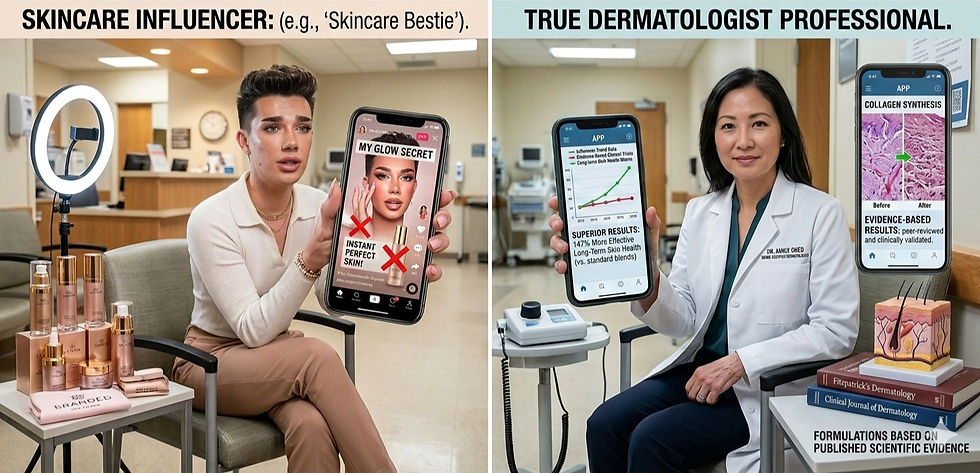
A cross-sectional study of dermatology content shared on major social networks found that 44.7% was rated as inaccurate and 20% as confusing — meaning nearly two-thirds of what patients encounter online is misleading. And the inaccurate content generated significantly more engagement than the accurate content.
Misinformation doesn't just exist alongside good information. It outcompetes it.
The solution isn't to dismiss patients who arrive with steroid fears. They're not irrational — they're responding rationally to irrational information. The solution is to meet them where they are, acknowledge the fear, and then do what we do best: show them the evidence.
Because the most dangerous thing in dermatology right now isn't a tube of hydrocortisone.
It's a phone.


Comments