Rosacea Is Not Adult Acne (And Your Makeup Didn't Cause It)

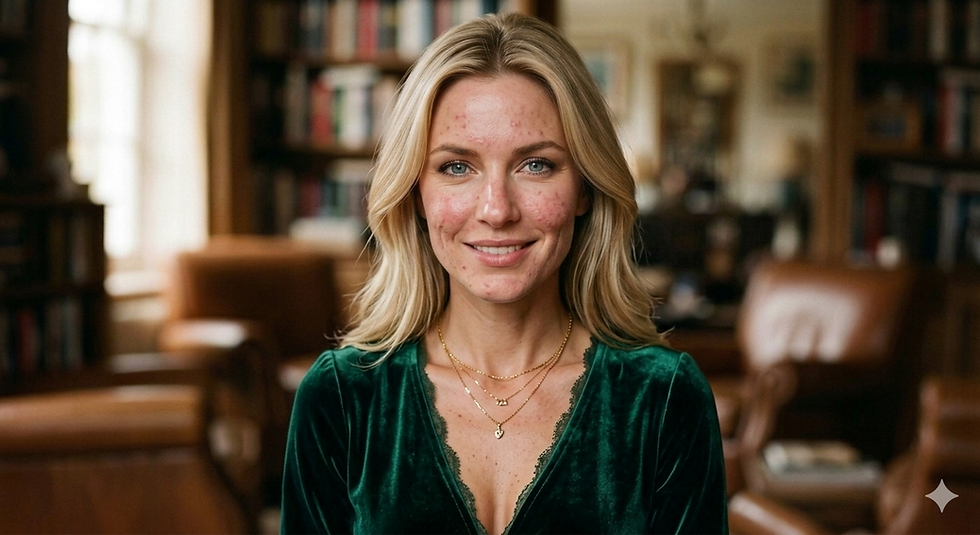
Let me tell you about a conversation I have almost every week...
Someone sits down across from me, points to the flush across their cheeks and nose, and says some version of the same sentence: "I don't understand—I'm forty-three years old, why am I breaking out like a teenager? Is it my foundation? Should I throw out my makeup?"
And I get to do one of my favorite things in medicine. I get to hand somebody back a piece of the truth.
So here's the truth: what you have is probably not acne. And your makeup almost certainly didn't cause it.
What you're describing has a name—rosacea—and understanding what it actually is changes everything about how you treat it, how you feel about it, and how much money you stop wasting on products that were never going to work.
Acne and rosacea are two different stories
They can look like cousins from across the room. Both bring redness. Both bring bumps. But up close, they're telling completely different stories.
Acne is fundamentally a plumbing problem. Pores get clogged with oil and dead skin, bacteria move in, and you get blackheads and whiteheads—those little plugged pores called comedones. That word matters, so hold onto it.
Rosacea is not a plumbing problem. It's more like a wiring problem and an alarm-system problem. In rosacea, the blood vessels in your face are hair-triggered—they flush and stay flushed. Your skin's own immune system is running hot, sounding alarms when there's no fire. Sometimes tiny, ordinary skin mites called demodex (we all have them) tip the balance and add to the inflammation. The result is that deep central-face redness, sometimes visible little blood vessels, and bumps that can look like acne but aren't clogged pores at all.

Here's the tell that separates them, the thing I look for: comedones—blackheads and whiteheads—belong to acne. Rosacea doesn't make them.
If you've been fighting "adult acne" for years with acne products and losing, this is often why. You've been using the right map for the wrong country.
Let's clear the record on the myths
The internet has a lot to say about rosacea, and much of it is confidently wrong. A few I want to put down for good:
"It's just adult acne." No. It's a separate, chronic condition of the facial skin, with its own biology.
"My makeup caused it." It didn't. Rosacea comes from a mix of genetics and an overreactive immune and blood-vessel response—not from your foundation. Makeup didn't hand you this.
"It only happens to older, fair-skinned people." It's more common in fair skin, but it absolutely occurs in every skin tone—and it's frequently missed in deeper skin, which is its own quiet injustice.
"There's a cure if I just find the right miracle product." There isn't a cure. But—and this is the good part—there is real, effective control.
Now, the nuance—because you deserve the whole truth
Here's where I have to be honest and not oversimplify. Makeup didn't cause your rosacea. But how you treat your skin can absolutely calm it down or wind it up.
Rosacea skin has a fragile barrier—think of a brick wall with crumbling mortar. So the harsh stuff many of us were taught meant "clean" is exactly what makes it worse: scrubbing, foaming cleansers that leave your face squeaky, washing twice a day like you're scouring a pan, piling on strong actives, aggressive salon facials. These don't cause the disease, but they poke the bear.
So the makeup itself isn't the villain. The villain is the war we sometimes wage on our own faces trying to fix it.

What actually helps
The good news is that the things that work are mostly gentle, and mostly within your control:
Be tender with your skin. A soap-free, gentle cleanser. Once or twice a day, no scrubbing. Fragrance-free moisturizer to rebuild that mortar in the wall. Boring, and it works.
Wear sunscreen every single day. Ultraviolet light is one of the most reliable triggers there is. A broad-spectrum SPF 30 or higher—mineral formulas with zinc oxide or titanium dioxide tend to be gentlest—is one of the most protective things you can do.
Learn your triggers. For most people it's some personal mix of sun, heat, stress, spicy food, and alcohol (red wine is a famous offender). Keep a simple diary for a few weeks. Your face will start to tell you its rules.
Makeup is allowed. You don't have to throw it out. Gentle, fragrance-free products—and yes, color-correcting cosmetics to cover redness—are completely fine and can be genuinely good for morale.
See a professional and treat the actual disease. This is the part the miracle-serum world doesn't tell you: rosacea has real, proven medical treatments. Prescription creams and gels for the bumps and redness, options aimed specifically at the flushing, oral medications for tougher cases, and laser or light treatments for stubborn visible vessels. A dermatologist or your doctor can match the treatment to your particular kind of rosacea.
The part I most want you to hear
If you've spent years quietly believing your face is your own fault—that you eat wrong, wash wrong, or chose the wrong makeup—I want to gently set that burden down for you.
You didn't cause this. It's not poor hygiene. It's not vanity gone wrong. It's a common, understood medical condition, and it responds to the right care. Rosacea can weigh on people more than the redness alone would suggest; the frustration and self-consciousness are real, and they're worth taking seriously too.
So stop fighting the wrong battle. Put down the harsh scrubs and the acne washes that keep letting you down. Be kind to the skin you're in—and go get a diagnosis and a plan that actually fits what you have.
Your face isn't a problem to punish. It's a patient to care for. Start there.


Comments